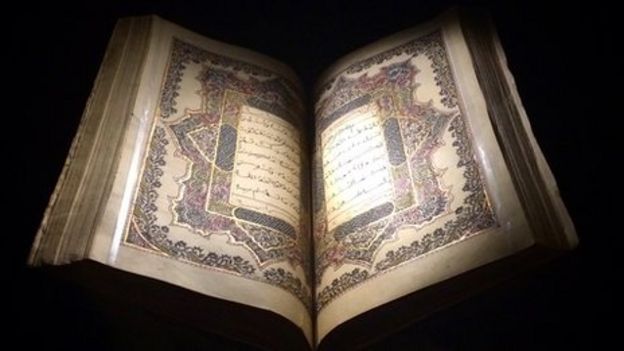
Salamunalaikum WBT.....All praise on Allah SWT....
Hi folks...it has been a while since my last posting..my apology...Alhamdulillah, I was being promoted and has since been extremely a roller coaster ride....
Anyhow, please expand our horizon and watch this....
FOR BETTER ORAL HYGIENE: Some pilgrims buy miswak to be given as gifts to family and friends back home.
ARAB NEWS
Published — Monday 27 July 2015
Last update 27 July 2015 2:19 am
MADINAH: Millions of visitors coming to Madinah during Ramadan and Eid made sure they visited the miswak market. People from many different nationalities flocked to buy the product either for personal use or to give as gifts to their family and friends once they return home from one of the holiest sites on earth. Miswak sticks, also known as the best tooth cleanser, can be found in every corner of the holy city. Some of the miswak are manufactured and are packaged in colorful paper boxes while others of wood in different sizes and types are placed in front of the sellers. Miswak have medicinal properties to fight plaque, recession of gums, tooth decay, bleeding gums and other dental issues. Users start off by chewing the Miswak until it softens and forms bristles so they can use it as a toothbrush but without toothpaste. Some sellers stand for more than 12 hours in front of their stalls hoping to attract as many customers as possible. Seller Abu Mohammed says that most of his clients are from the Gulf and Muslim countries explaining that the best type of miswak is the one dubbed “Abu Hanash” because it looks like the Hanash snake skin. Saad, a miswak seller, said that miswak sales during Ramdan and the Eid skyrocket to around SR500,000 in the city’s central area alone. Merchants told Arab News that prices differ from one place to another as “in Madinah, most sellers import miswak from Jeddah and Makkah. So, because of this we need to sell more so we can regain our capital and make a profit,” said Abu Mohammed. He said that he usually imports SR20,000 worth of Miswak during Ramadan and Eid noting that the amount he buys to sell during the Haj season is a different quantity. Most of Abu Mohammad’s clients usually buy miswak to give as gifts to their friends and family back home adding that people usually buy around SR500 to SR1,000. Abu Mohammed told local media that his best seller is Abu Hanash, one of the best types of Miswak which is sold for a high price. He explained that a good miswak should be moderately thick with a burning flavor, in addition to its white color, beautiful smell, integrity and without any bends. He warned customers to be careful of cheats, explaining that some miswak sellers try to make their old miswak products look fresh so they soak them in a mix of water and ginger and then cool them off to dupe the customer.
JEDDAH: Millions of Muslims from all over the world visit the Makkah region every year for Umrah and Haj. To cover all the emergencies and health requirements, the government plans to offer 10,454 beds with 20,000 health facilities in the next five years in different areas of the region.
Makkah Gov. Prince Khaled Al-Faisal emphasized the importance of delivering the full range of health services at all provincial centers to the public.
He stressed the need to complete health projects in the region in accordance with the scheduled time without delay. The objectives and the advancement of medical services are needed by the holy sites and the people of, and visitors to, the region.
The health strategy takes into account the reality of curative and preventive services as well as manpower in the health sector in the region’s performance. Over the next five years, the workforce in health-related occupations in the region, now 36,877 employees, will rise to 70,085.
The projects currently under way are Jeddah Medical Tower for Childbirth and Children with the capacity of 400 beds; Eye Medical Tower in Jeddah with the capacity of 200; Psychiatric Hospital in Jeddah with a capacity of 500 beds; Al-Jamum Hospital with a capacity of 100 beds; Makkah Hospital with a capacity of 500 beds; Women’s Hospital in Qunfudah with the capacity of 200 beds; Amal Mental Hospital in Taif with a capacity of 500 beds; Children’s Hospital in Taif with 300 beds.
The projects that are under study for construction are King Faisal Medical Tower in Makkah with 200 beds; Children’s Hospital in Makkah with 300 beds; Bil-Harith Hospital with 50 beds; Qunfudah Hospital with 50 beds; King Fahd Medical Tower in Makkah with 200 beds; Namira Hospital with 50 beds; South Qunfudah Hospital with 100 beds; Umm Al-Doom Hospital in Taif with 50 beds; Al-Laith Hospital with 100 beds; North Jeddah Hospital with 200 beds; King Abdul Aziz Medical Tower in Makkah and King Faisal Hospital in Taif.
OIC condemns Israeli desecration of Al-Aqsa Mosque
New
Israeli security forces scuffle with a Palestinian woman after authorities limited access for Muslim worshipers to the Al-Aqsa mosque compound in the old city of Jerusalem on Sunday. (AFP PHOTO / AHMAD GHARABLI)
ARAB NEWS
Published — Monday 27 July 2015
Last update 26 July 2015 9:10 pm
JEDDAH: The Organization of Islamic Cooperation (OIC) on Sunday urged the international community, particularly the UN Security Council, to take action against “repeated and dangerous Israeli violations of holy sites.”
In a statement carried by the Saudi Press Agency (SPA), the 56-nation group made the call after violence erupted on Sunday as Israeli security forces attacked Palestinians protesting access by Jews into the compound on an annual day of Jewish mourning.
OIC Secretary-General Iyad bin Ameen Madani denounced the “incursion into and desecration of the blessed Al-Aqsa Mosque by groups of extremist settlers under the protection of the Israeli occupation forces” as “an act of provocation and blatant violation of relevant international resolutions and instruments.”
He said the settlers blocked access to the mosque and “savagely attacked” the worshippers in the mosque's compound.
Madani said it was holding Israel “fully responsible for the consequences of the continuation of these systematic Israeli attacks against the blessed Al-Aqsa Mosque which fuel religious conflict, extremism and instability in the region.”
Palestinians were angered by what they considered intrusions by Jews. Visits are allowed, but Jewish prayer at the site is prohibited.
The hilltop compound in Jerusalem's Old City, one of the biggest flashpoints in the Middle East, is the most sacred site in Judaism and Islam's third holiest, after Makkah and Madinah. Jews refer to the site as the Temple Mount.
Israeli police said Palestinian youths had prepared to clash with them, spending the night in the mosque in which they had stored stones and fireworks, as well as wooden planks to prevent police from closing the doors.
Police said they only went a few meters into the mosque to shut the doors in a bid to restore calm and lock in rioters who were inside.
The Palestinian government said Israel’s actions proved it wanted to “drag the region into a religious war.”
Jordan, the custodian of the compound, said: “The repeated Israeli violations of the sanctity of the holy site are a provocation against the feelings of Arabs and Muslims... designed to ignite further hostility.”
Media captionThe university's academics were "startled" when the radiocarbon dating tests showed it was so old
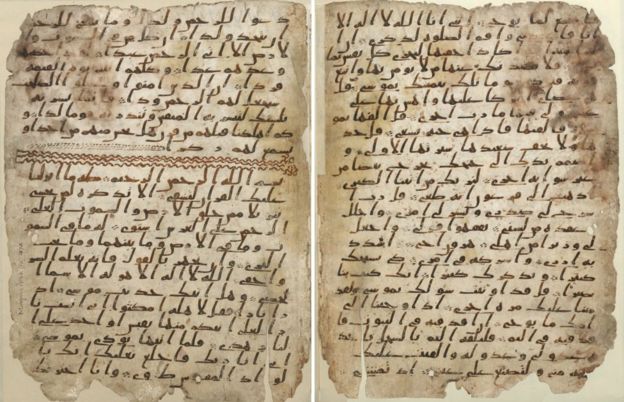
What may be the world's oldest fragments of the Koran have been found by the University of Birmingham.
Radiocarbon dating found the manuscript to be at least 1,370 years old, making it among the earliest in existence.
The pages of the Muslim holy text had remained unrecognised in the university library for almost a century.
The British Library's expert on such manuscripts, Dr Muhammad Isa Waley, said this "exciting discovery" would make Muslims "rejoice".
The manuscript had been kept with a collection of other Middle Eastern books and documents, without being identified as one of the oldest fragments of the Koran in the world.
The fragments were written on sheep or goat skin
Oldest texts
When a PhD researcher, Alba Fedeli, looked more closely at these pages it was decided to carry out a radiocarbon dating test and the results were "startling".
The university's director of special collections, Susan Worrall, said researchers had not expected "in our wildest dreams" that it would be so old.
"Finding out we had one of the oldest fragments of the Koran in the whole world has been fantastically exciting."
The tests, carried out by the Oxford University Radiocarbon Accelerator Unit, showed that the fragments, written on sheep or goat skin, were among the very oldest surviving texts of the Koran.
These tests provide a range of dates, showing that, with a probability of more than 95%, the parchment was from between 568 and 645.
"They could well take us back to within a few years of the actual founding of Islam," said David Thomas, the university's professor of Christianity and Islam.
"According to Muslim tradition, the Prophet Muhammad received the revelations that form the Koran, the scripture of Islam, between the years 610 and 632, the year of his death."
Prof Thomas says the dating of the Birmingham folios would mean it was quite possible that the person who had written them would have been alive at the time of the Prophet Muhammad.
"The person who actually wrote it could well have known the Prophet Muhammad. He would have seen him probably, he would maybe have heard him preach. He may have known him personally - and that really is quite a thought to conjure with," he says.
First-hand witness
Prof Thomas says that some of the passages of the Koran were written down on parchment, stone, palm leaves and the shoulder blades of camels - and a final version, collected in book form, was completed in about 650.
He says that "the parts of the Koran that are written on this parchment can, with a degree of confidence, be dated to less than two decades after Muhammad's death".
"These portions must have been in a form that is very close to the form of the Koran read today, supporting the view that the text has undergone little or no alteration and that it can be dated to a point very close to the time it was believed to be revealed."
to be revealed."
Media captionSusan Worrall says the university wants to put this internationally significant discovery on public display
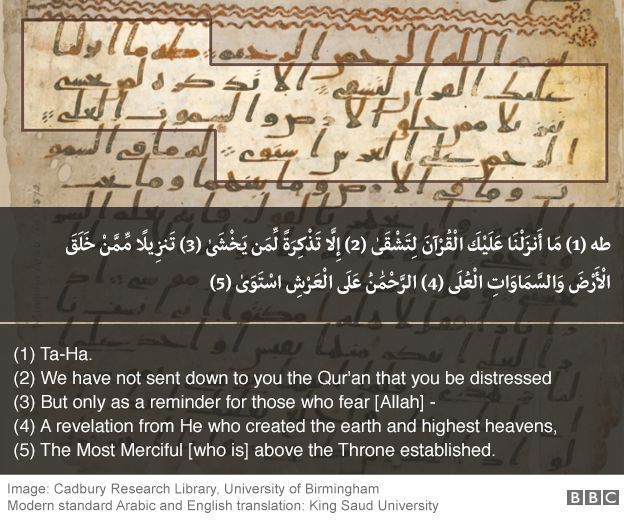
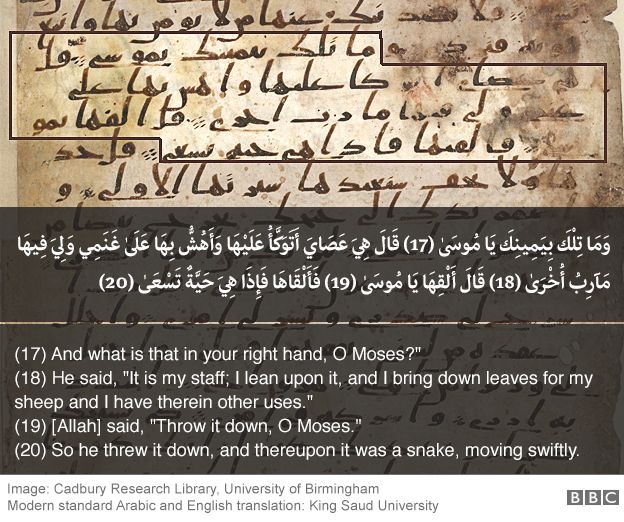
The manuscript, written in "Hijazi script", an early form of written Arabic, becomes one of the oldest known fragments of the Koran.
Because radiocarbon dating creates a range of possible ages, there is a handful of other manuscripts in public and private collections which overlap. So this makes it impossible to say that any is definitively the oldest.
But the latest possible date of the Birmingham discovery - 645 - would put it among the very oldest.
'Precious survivor'
Dr Waley, curator for such manuscripts at the British Library, said "these two folios, in a beautiful and surprisingly legible Hijazi hand, almost certainly date from the time of the first three caliphs".
The first three caliphs were leaders in the Muslim community between about 632 and 656.
Dr Waley says that under the third caliph, Uthman ibn Affan, copies of the "definitive edition" were distributed.
Muhammad Afzal of Birmingham Central Mosque said he was very moved to see the manuscript
"The Muslim community was not wealthy enough to stockpile animal skins for decades, and to produce a complete Mushaf, or copy, of the Holy Koran required a great many of them."
Dr Waley suggests that the manuscript found by Birmingham is a "precious survivor" of a copy from that era or could be even earlier.
"In any case, this - along with the sheer beauty of the content and the surprisingly clear Hijazi script - is news to rejoice Muslim hearts."
The manuscript is part of the Mingana Collection of more than 3,000 Middle Eastern documents gathered in the 1920s by Alphonse Mingana, a Chaldean priest born near Mosul in modern-day Iraq.
He was sponsored to take collecting trips to the Middle East by Edward Cadbury, who was part of the chocolate-making dynasty.
The Koran
Muslims believe the words of the Koran were revealed to the Prophet Muhammad by the angel Gabriel over 22 years from 610
It was not until 1734 that a translation was made into English, but was littered with mistakes
Copies of the holy text were issued to British Indian soldiers fighting in the First World War
On 6 October 1930, words from the Koran were broadcast on British radio for the first time, in a BBC programme called The Sphinx
The local Muslim community has already expressed its delight at the discovery in their city and the university says the manuscript will be put on public display.
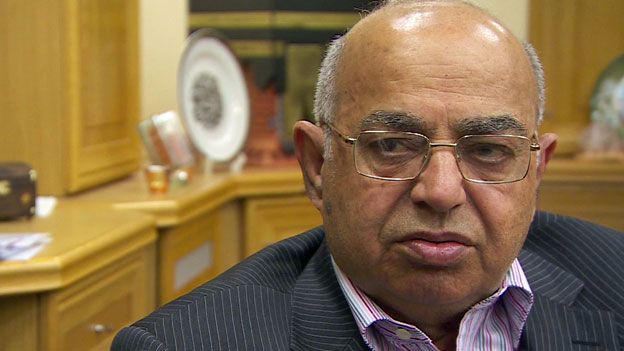
"When I saw these pages I was very moved. There were tears of joy and emotion in my eyes. And I'm sure people from all over the UK will come to Birmingham to have a glimpse of these pages," said Muhammad Afzal, chairman of Birmingham Central Mosque.
The university says the Koran fragments will go on display in the Barber Institute in Birmingham in October.
Prof Thomas says it will show people in Birmingham that they have a "treasure that is second to none".
MAKKAH — There are about a million copies of the Qur'an placed in as many as 3,750 shelves in the Grand Mosque for the use of pilgrims and visitors.
Mohamed Riyyal Al-Silani, director of the department of books in the Presidency of the Affairs of the Two Holy Mosques, said there are 45 translations of the meanings of the holy book available for pilgrims from various nationalities.
He told Makkah daily that there are translations into English, French, Urdu, Hindi, Turkish and other languages. – SG